
Coastal Soil IntelligenceData-driven infrastructure for resilient coasts.
Sensor networks and AI verification for coastal land — built for municipalities, utilities, and resilience operators facing saltwater intrusion, stormwater stress, and climate-driven soil change.
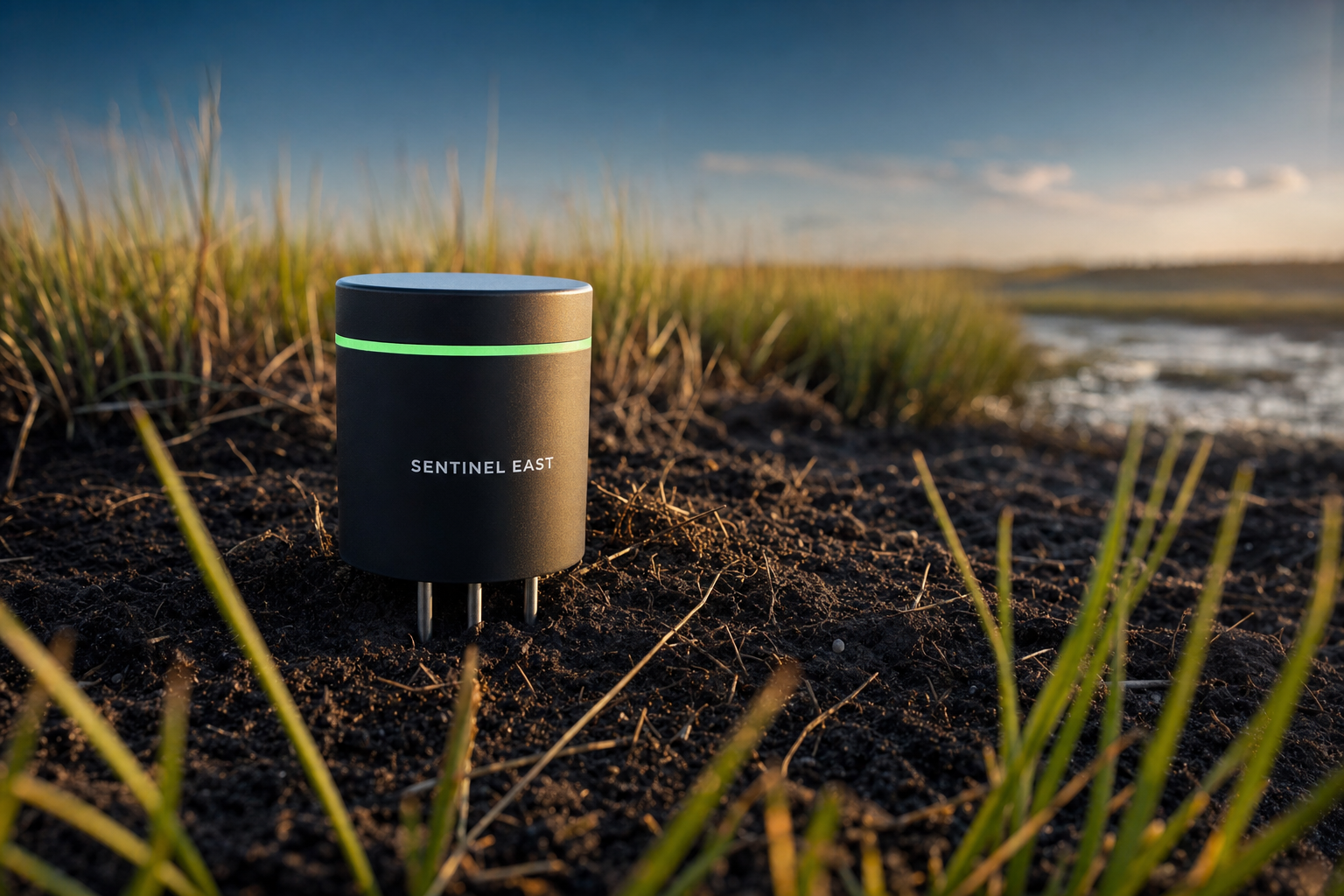

Soil is the operational layer
beneath every climate system.
Roads, grids, and water systems get sensor networks and operations software. Soil — the substrate they all depend on — does not. We're changing that.
Six failures of land data — replaced by one operational system.
Each row below shows the manual status quo and the Sentinel East replacement workflow.
Eight systems. One operational layer.
Every deployment ships these components — configured to the operator's parcels, workflows, and climate exposure.
From soil column to operator dashboard — one continuous data path.
Three architectures, one infrastructure pattern. Every layer is auditable, replaceable, and operator-controlled.
Inference at the edge, evidence in the soil.
Every Sentinel East site runs an AI model on the LoRaWAN gateway itself — no cloud dependency, no outage risk, sub-second response. The model fuses multi-depth probe data with satellite NDVI, NOAA hydrology, and local climate projections to produce recommendations that are gated on a 2030 and 2050 viability check.
- Edge AI. Inference runs on the gateway. Works offline. No vendor cloud lock-in.
- Multi-layer telemetry. Microbial, NPK, salinity, moisture, temperature, EC — per depth band.
- Climate-verified outputs. Every recommendation passes a 2030 + 2050 sea-level + drought scenario.
- 16-agent research swarm. Multi-agent AI swarm prioritizes the highest-leverage interventions in your soil-of-record.
[09:14:02] sensors: 38 packets · 4 depths · gateway RAK7268V2
[09:14:02] model:   sentinel-soil-v3 · 612ms · edge
[09:14:03] ai:      microbial Δ +0.03 · within band
[09:14:03] climate: 2030 ✓  2050 ✓  recommendation valid
[09:14:04] route:   ops-dashboard · operator: cape-may-12
[09:14:05] action:  advisory issued · cover-crop window
Productized installation. Zero ambiguity.
A fixed-scope, fixed-timeline rollout that ends with a fully operational soil infrastructure system — not a slide deck.
- Site walk + parcel inventory
- Workflow mapping
- Soil-of-record ingestion
- Climate exposure profile
- Sensor placement
- Gateway provisioning
- Edge AI configuration
- Satellite & weather integration
- Operator training
- Dashboard handoff
- Reporting workflows
- Ongoing monitoring SLA
Outcomes operators can put in a budget memo.
Indicative ranges from pilot deployments and comparable field-data benchmarks. Sentinel East commits to a measured baseline at install.
What 90 days of soil infrastructure looks like
on a single coastal parcel.
A 240-acre coastal NJ parcel flagged 'marginal' by every conventional soil lab. The deployed sensor network and on-gateway model surfaced what standard testing missed.
Projected lift from "marginal" to productive tier in a single growing season.
vs. ~180 days for a conventional soil consulting engagement.
EQIP practice codes mapped automatically from the intervention plan.
One platform. Six operator profiles.
The same Sentinel East stack configures differently for each operator class — same telemetry, different workflow.
Every deployment ships with a named operator.
We don't drop software and disappear. Each install comes with a named Sentinel East operator who walks the site, configures the model, trains your staff, and remains the human accountable for the system. AI accelerates the work — people own the outcome.
- Named install operator + 90-day handover SLA
- Every AI recommendation logged with provenance
- Override and audit controls on every workflow
Built to a public-sector trust standard.
Sentinel East is a soil-data system of record. We treat it like one — with the controls, logging, and human oversight that infrastructure software demands.
Land that runs
like a system.
The next decade of climate operations won't be won with policy memos. It will be won with continuous land telemetry, edge intelligence, and operator workflows that act on it before damage compounds. Sentinel East is building that operating system.
A named operator. Accountable from install to outcome.
Every Sentinel East deployment ships with a named operator who walks your site, configures the model, trains your team, and remains the human accountable for the system. That operator, today, is the founder.
Joaquin built Sentinel East to solve a specific operational problem: the systems that decide what our land does — stormwater plans, conservation budgets, climate-resilience grants — still run on soil data from the 1970s. That isn't an information problem. It's an infrastructure problem. Sentinel East replaces the substrate with continuous telemetry, edge AI, and workflows public-sector teams can actually run.
Background spans AI agent development, LoRaWAN / IoT networks, and municipal operations strategy. Advised by Steven Oakie, SCORE Greater Philadelphia. Sentinel East Technologies LLC is registered in New Jersey.

- • LoRaWAN / IoT systems
- • AI agent development
- • Municipal operations strategy